The History of Little Falls, Minnesota
A river town that a sawmill started, a railroad rescued, and the lumber barons Weyerhaeuser and Musser turned into one of the busiest milling centers in the Upper Midwest.
Little Falls grew up around a set of rapids on the Mississippi River. A sawmill and dam went up in 1849 to supply nearby Fort Ripley; the town incorporated in 1889; and in the 1890s the Pine Tree Lumber Company — run by Charles Weyerhaeuser and Drew Musser — made it a milling powerhouse that nearly doubled the population in a decade.
The falls that named the town
Before it was a town, it was a sound: water dropping over a ledge of slate and granite where the Mississippi narrowed. The Ojibwe called the place Kakabikans. In 1805 Lieutenant Zebulon Pike, mapping the upper river for the U.S. Army, wrote of "a remarkable rapid in the river, opposite a high piny island." The French cartographer Joseph Nicollet marked it petites chutes — little falls. The rapids are gone today, submerged behind the dam that replaced them, but they are the reason a settlement took root here at all.
Fort Ripley, a sawmill, and a false start
The first real activity came from the military. When the Army built Fort Ripley a few miles upriver in the late 1840s, someone had to supply the lumber. In 1849 James Green, counted as the area's first permanent settler, put up a dam and a sawmill at the falls, and the Little Falls Mill and Land Company formed the same year to develop the water power. It was a sensible plan in the wrong decade. The early dam washed out in the 1850s, the first speculative boom faded, and for a generation Little Falls stayed small.
What changed its fortunes was track. When the Northern Pacific Railroad reached town, lumber and goods could move in volume without depending on the river alone. The combination the founders had wanted — water power, a river full of logs, and a way to ship the finished boards — finally lined up. Little Falls incorporated as a city in 1889.
Pine Tree Lumber and the Weyerhaeuser name
The turning point arrived in 1890, when the Pine Tree Lumber Company was organized to build a mill on the riverbank. Two men ran it: Charles A. Weyerhaeuser, son of the timber magnate Frederick Weyerhaeuser, and Richard "Drew" Musser. Weyerhaeuser managed the logs and the mill; Musser handled sales and the books. Commercial sawing began on May 18, 1891.
Little Falls suited the operation almost perfectly. The dam created a broad boom above town where logs floated down the Mississippi could be held and sorted, and the Northern Pacific line ran straight through to carry lumber out. The mill employed several hundred men, and within ten years the town's population had roughly doubled.
| Organized | 1890; first commercial run May 18, 1891 |
|---|---|
| Founders | Charles A. Weyerhaeuser and Richard "Drew" Musser |
| Peak output | About 76 million board feet in 1902 |
| Final run | 1919, after the surrounding pine was cut over |
| Total production | More than 1.5 billion board feet over 27 years |
The mill made its last run in 1919, once the great pine stands upriver had been logged off — the same arc that played out across the northern Minnesota timber country. Over 27 years it had cut more than 1.5 billion board feet. The Weyerhaeuser company that grew into one of the world's largest forest-products firms traces part of its roots to this Little Falls operation.
What the lumber money left behind
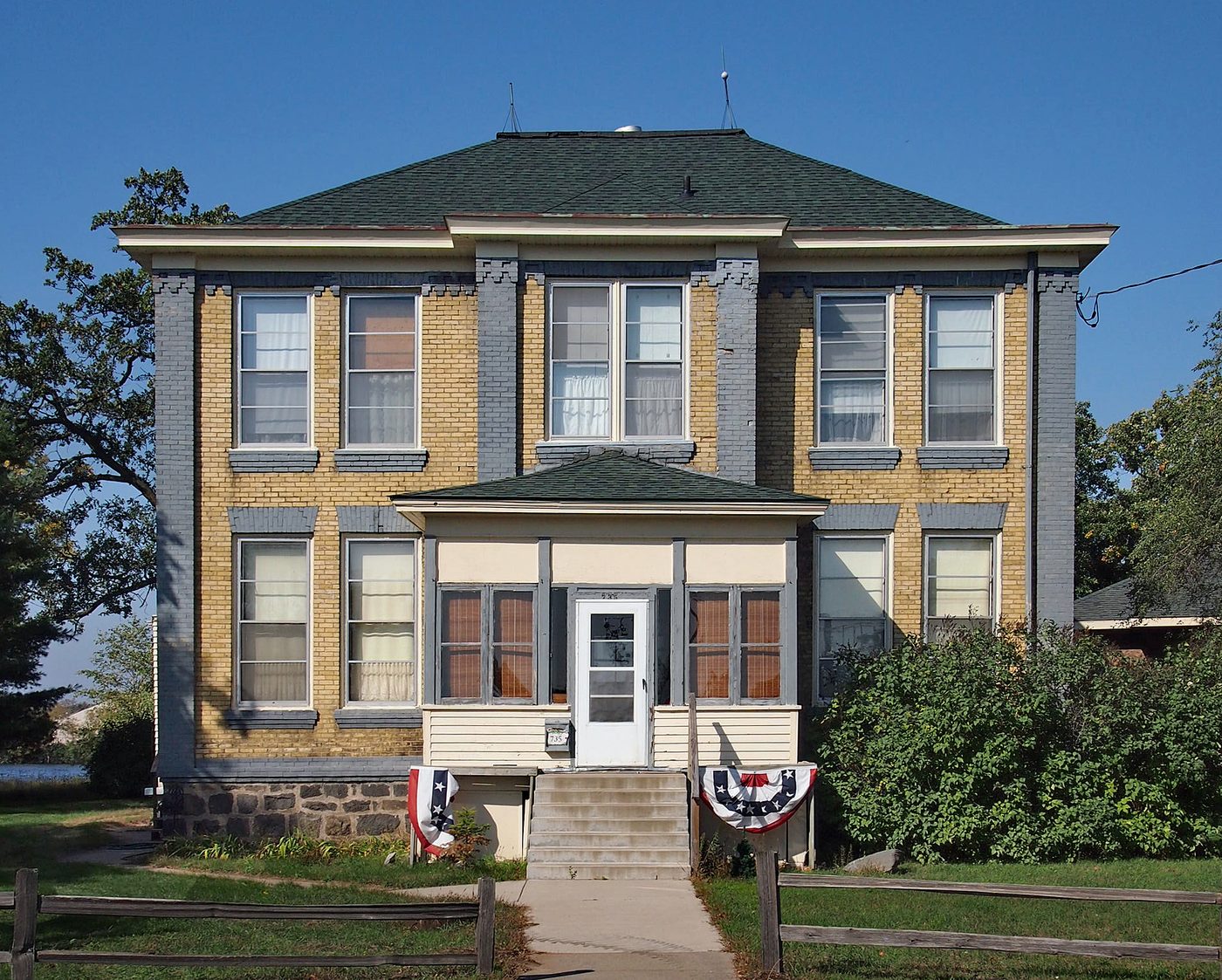
The families who ran the mill did not just work in Little Falls; they lived there, and they built. Weyerhaeuser and Musser raised neighboring mansions on the riverbank that survive today as Linden Hill, a preserved historic estate. The county's broader story — settlement, logging, and life on the river — is kept at the Charles A. Weyerhaeuser Memorial Museum, run by the Morrison County Historical Society.
After the sawdust settled
A lumber town has to answer one hard question when the trees run out: what now? Little Falls answered it by staying useful. As the Morrison County seat it kept the courthouse, the commerce, and the institutions that outlast any single industry, and it settled into its role as a market center for the surrounding farm country. The dam that once corralled logs was converted to generate electricity, a job it still does. The result is the town you find now — a walkable county seat of about 9,000 people with a historic downtown, a state park, and a river that still runs through the middle of everything.
For the wider view of how the river and the dam shaped the town, continue to The Mississippi River and the Little Falls Dam, or read how the town produced its most famous son in Charles Lindbergh and Little Falls.

Michael Paycer
Michael Paycer grew up in Little Falls, Minnesota. Today he is a Senior SQL Server Database Administrator Consultant based in Saint Cloud, and he keeps this Little Falls guide as a personal project about his hometown.
Sources & further reading
- City of Little Falls — City History
- Wikipedia — Little Falls, Minnesota
- Forgotten Minnesota — The Pine Tree Lumber Company
- Morrison County Record — Weyerhaeusers' lasting legacy in Little Falls
- Linden Hill Historic Estate — History
External sites are provided for reference. Event dates, hours, and admission change annually — confirm current details with the official source before visiting.